

Your kitchen faucet is undoubtedly one of the fixtures you use most often in your home. That’s why it’s essential to pay particular attention to quality, as well as esthetics, when choosing one.
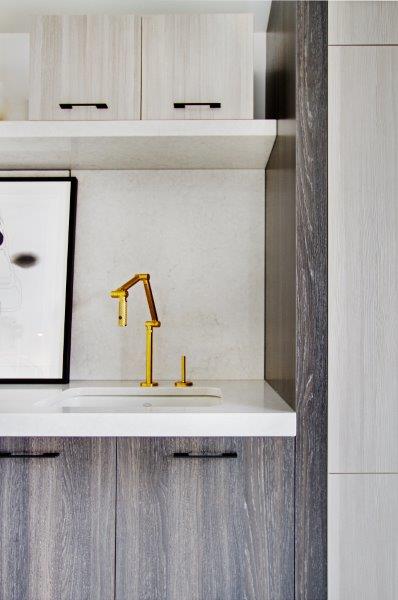
When the time comes to shop for a kitchen faucet, you’ll quickly notice that you have a wide variety of styles to choose from. The first thing you’ll need to do is set a budget. However, bear in mind that, in the end, it’s the design rather than the quality that will have the biggest impact on how much you’ll pay.
Second, try to determine which style best corresponds to your tastes, whether classic, contemporary, rustic or otherwise. No matter if you prefer a stainless steel kitchen faucet, a polished chrome faucet, a brushed or polished brass faucet, a brushed nickel faucet or a faucet that’s white, bronze or gold, you should know that there’s a vast selection on the market.
Before deciding on a specific model, you’ll need to make sure that the faucet is compatible with your kitchen sink. These days, the most popular faucets are single-handle models in which the same knob controls both the water flow and the temperature. Although this type of faucet is relatively simple to install, you should be aware that it’s designed for a single-hole sink. If you’re keeping your current sink and it has more than one opening, you’ll have to try to conceal the excess holes using caps or accessories, for example, a soap dispenser.
Of course, you can still find dual-handle faucets on the market, but they’re generally available in styles that are more traditional. If you opt for one of these models and need to drill additional holes in your sink, be sure to consult the installation manual before initiating this delicate work (keep in mind that stainless steel is relatively easy to drill, but be extra careful when attempting to drill a hole in a glass or ceramic sink).
When shopping for a faucet, pay special attention to the mechanical aspects. Forget about rubber gaskets. Instead, opt for a ceramic disc cartridge. It’s not only more resistant but also much easier to replace in the event of a problem.
You can also recognize the quality of a faucet by its finish. For example, faucets of lesser quality may be made of zinc, while those of greater quality will more often be made of solid brass plated with chrome, stainless steel or brushed steel. Please note, however, that a plastic head doesn’t necessarily mean that the faucet is of poor quality. In fact, since plastic doesn’t conduct heat as well as metal, the faucet may be easier to use.
Faucets are built to last for many years, so it isn’t uncommon for manufacturers to offer a lifetime guarantee on their products. That’s why you should avoid choosing a style of faucet that you’ll quickly grow tired of, as you’re probably going to be stuck with it for a very long time.
2019 CUISINES VERDUN. ALL RIGHT RESERVED.
 Find a branch